How IT’S
Made
FAQ: What is Damascus steel?
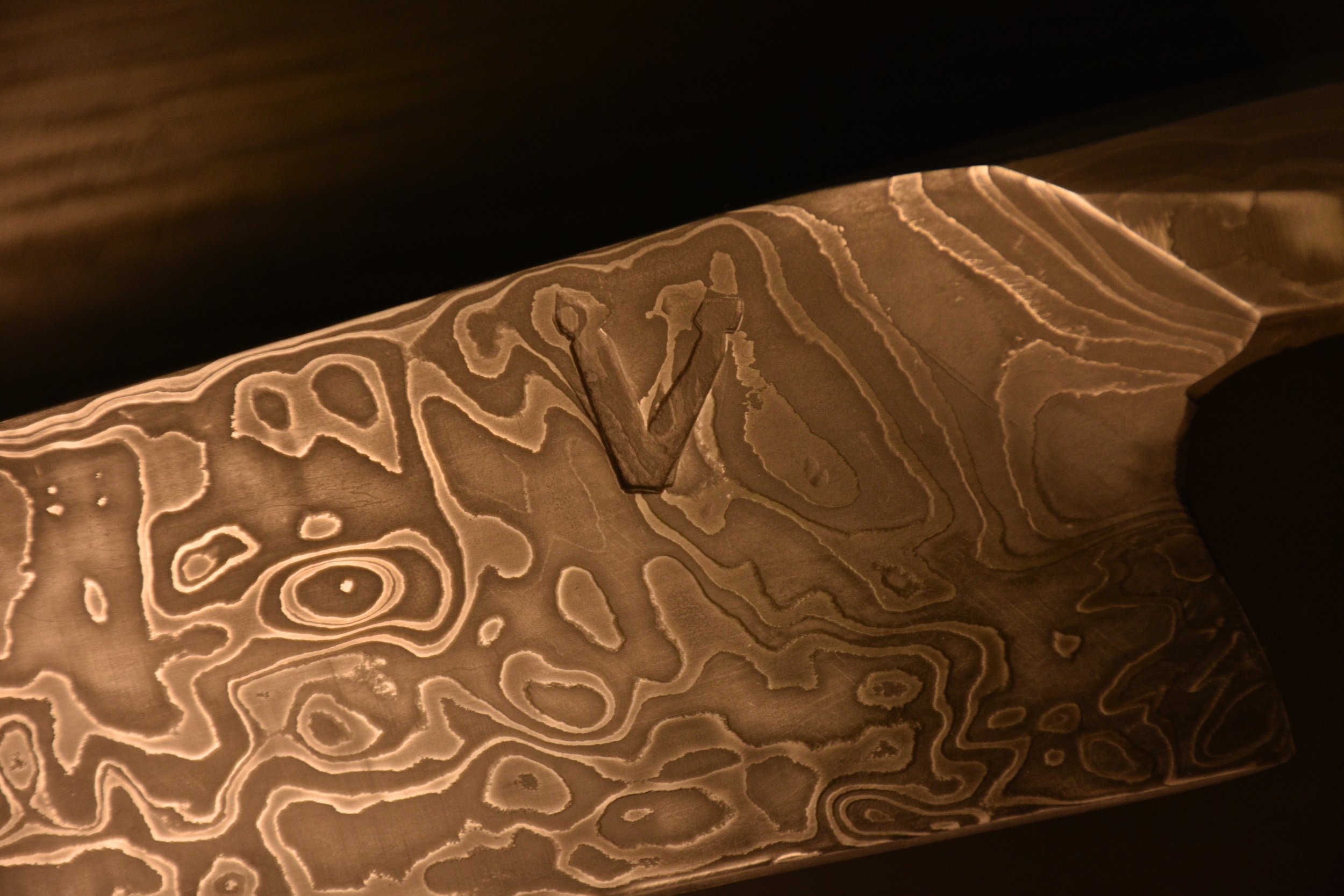
Damascus steel is the result of two types of steel being forged-welded together to create a solid chunk of metal; this is called a billet. The billet can be pinched, twisted, cut, and re-welded to create any pattern imaginable. As it is re-stacked, the number of layers increases. Once I forge a knife from the billet and grind the bevels, I etch the steel in a strong acid to reveal the pattern created during the forge-welding process.
The two steels that I use for Damascus are 1084 and 15N20. The “N” in 15N20 stands for its high 2% nickel content, which keeps it shiny while 1084 turns black during the etch.
VERY IMPORTANT: 1084 and 15N20 are both high-carbon steels, but are not stainless. Carbon steel performs better in both toughness and edge retention compared to stainless steel, but IT RUSTS IF LEFT WET. Proper care includes wiping the blade dry after use and intermittent oiling with Japanese camellia oil I include with every purchase. Stainless knives are also available if low maintenance is a priority!
HOW IT’S MADE:
Each knife takes 40+ hours from start to finish. I won’t bore you with every step, but here are some highlights.
A stack of alternating 1084 and 15N20 flat bar is welded together to form the billet.
The billet is heated to 2400 °F and then forged-welded together using the 16-ton hydraulic press.
The billet is then ground clean of any forge scale (surface oxidization) and re-stacked or twisted up to six times depending on the pattern.
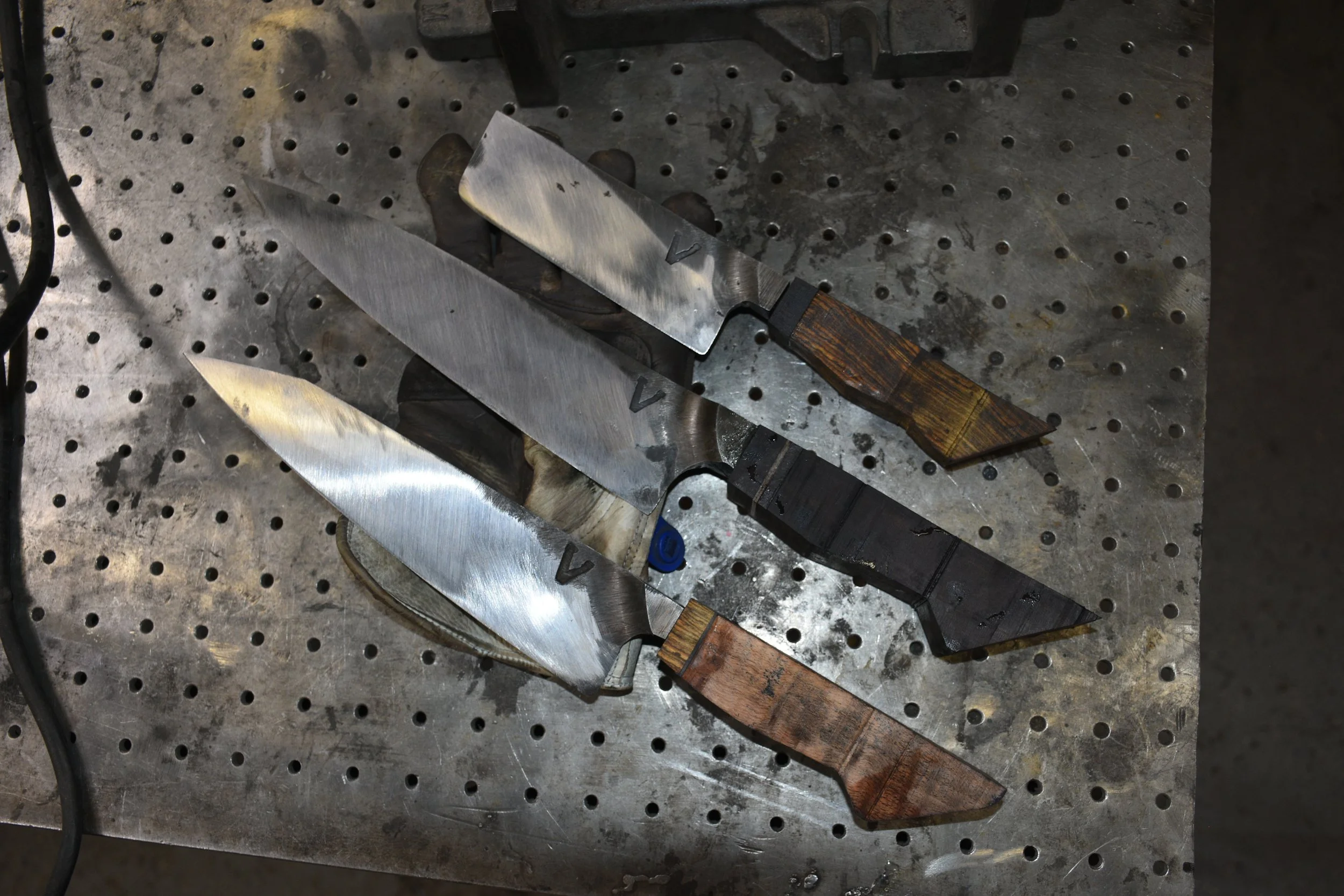
The blade is then forged from the billet.
The blade is rough-ground until the edge thins to a dime’s thickness.
There are three steps in the heat treating process. First I normalize the blade three times, a process of heating and slowly cooling the blade to relieve stresses in the microstructure created during forging. Next, the blade is quenched in oil to harden the steel. Finally, I temper the blade in an oven at 400 °F for four hours to increase the blade’s strength.
The blade is ground to its final thickness. I drill a hole in the handle material to fit the metal end of the knife (called a tang).
The blade is hand-sanded to 1500 grit and then cleaned before a two-step etch in Ferric Chloride and super-concentrated instant coffee. The blade is later wax treated to retain its finish.
Finally, the handle is sealed, glued up, and pinned. I sharpen the knife on a whetstone and send it off to you!